More than swamps
More than swamps
Forested wetlands contain rich biodiversity and provide valuable ecosystem services
WRITTEN BY MOLLY REES, KATE TURNER, AND JON MACNEILL
Published June 4, 2026
Discovering a thallus of rare lichen is not a common experience – but for staff from the Nature Trust of New Brunswick, entering a forested wetland is like a treasure hunt. Instead of metal detectors and shovels, they’re sporting gaiters and hand lenses as they search for specimens like White-rimmed shingle lichen (Fuscopannaria leucosticta) and Wrinkled shingle lichen (Pannaria lurida). What’s even better is when they can share this excitement with people who otherwise likely wouldn’t even notice lichens – organisms that may appear to the untrained eye as little more than a rough patch on the bark of a tree.
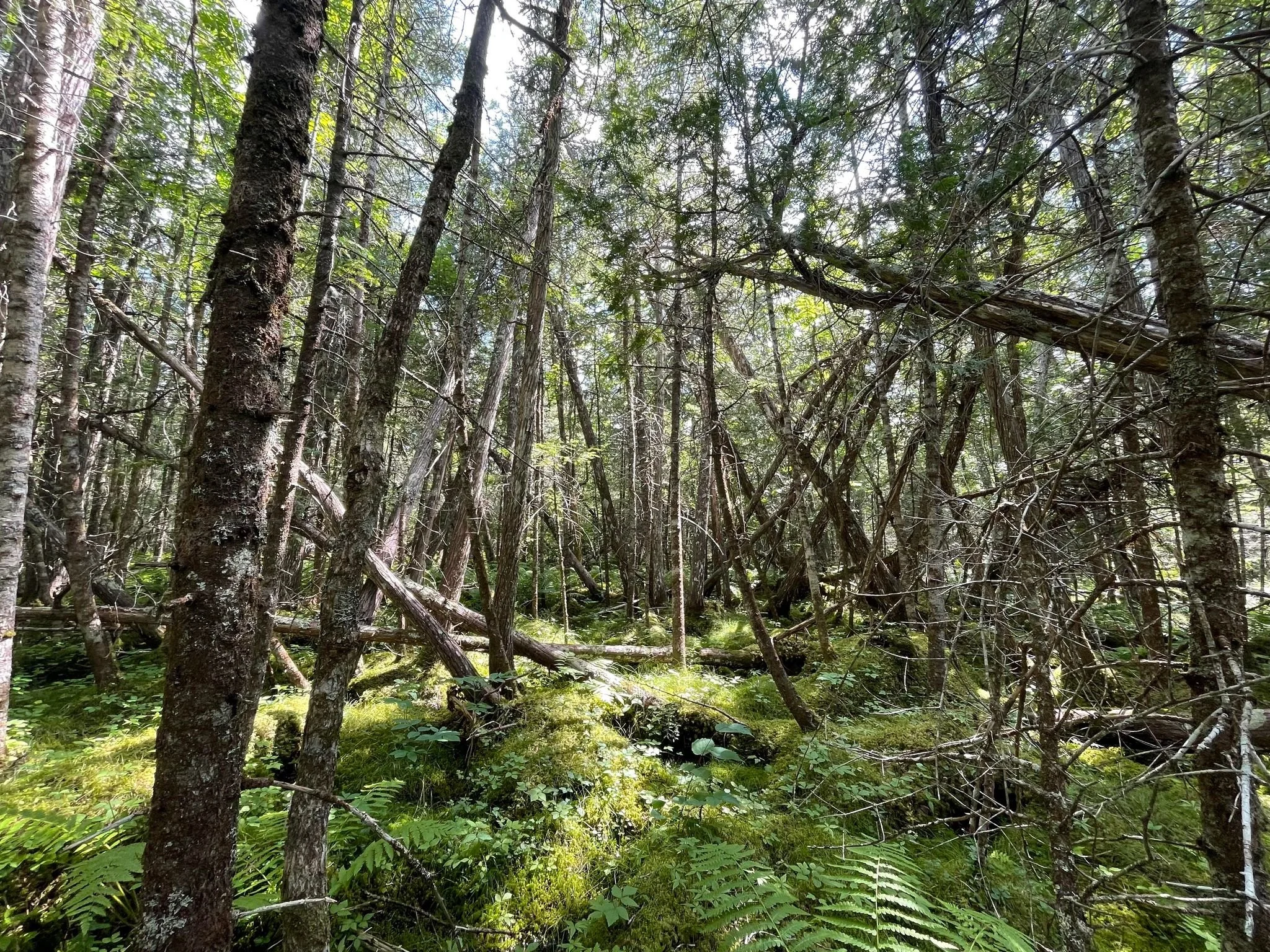
That’s what it was like for Ilana Urquhart, a conservation coordinator with the Nature Trust, as she led a forested wetlands workshop at the Beardsley Hill Nature Preserve in Woodstock, N.B., last fall. While the participants were enthralled by a patch of Pink lady slipper (Cypripedium acaule) orchids, Ilana instinctively turned toward the cedar trees growing at an angle of 60-70 degrees, knowing they are the preferred habitat for White-rimmed shingle lichen – a species-at-risk listed as “imperiled” (S2) in the province.
“Amazingly, one was right there,” she says, recalling the moment she found this previously undiscovered population. “Everyone already had the whole spiel about what to look for in cedar swamps, what the lichens look like, how rare they are, what they indicate – so when they got to see it in person so surprisingly, they were like, ‘Oh, this is cool!’ It was great. And then they were keen to follow me deeper into the swamp.”
The air of excitement certainly offset the discomfort of wet feet. But when you’re in the business of seeking lichens, getting your feet wet is often part of the job. These rare lichens are among the many species that depend upon the habitat characteristics of forested wetlands.
Forested wetlands are sometimes called the “cryptic wetlands,” because you can be standing in one and not even know it's a wetland. While some are easily identified by the presence of standing water and spongy soil, others are much less noticeable, though they still possess numerous ecological values. These values are important for the natural environment and for nearby communities. Forested wetlands prevent flooding, filter water, and store carbon, in addition to providing refuge for rare species such as the Canada warbler (Cardellina canadensis), the culturally significant Black ash (Fraxinus nigra), and the aforementioned lichens.
These ecosystems are under threat from development, resource extraction, and a lack of public awareness about their importance. To address this knowledge gap, the Nature Trust received funding from the Environmental Trust Fund in 2025 to host a series of workshops to equip landholders with the skills to recognize, protect, and manage forested wetlands.
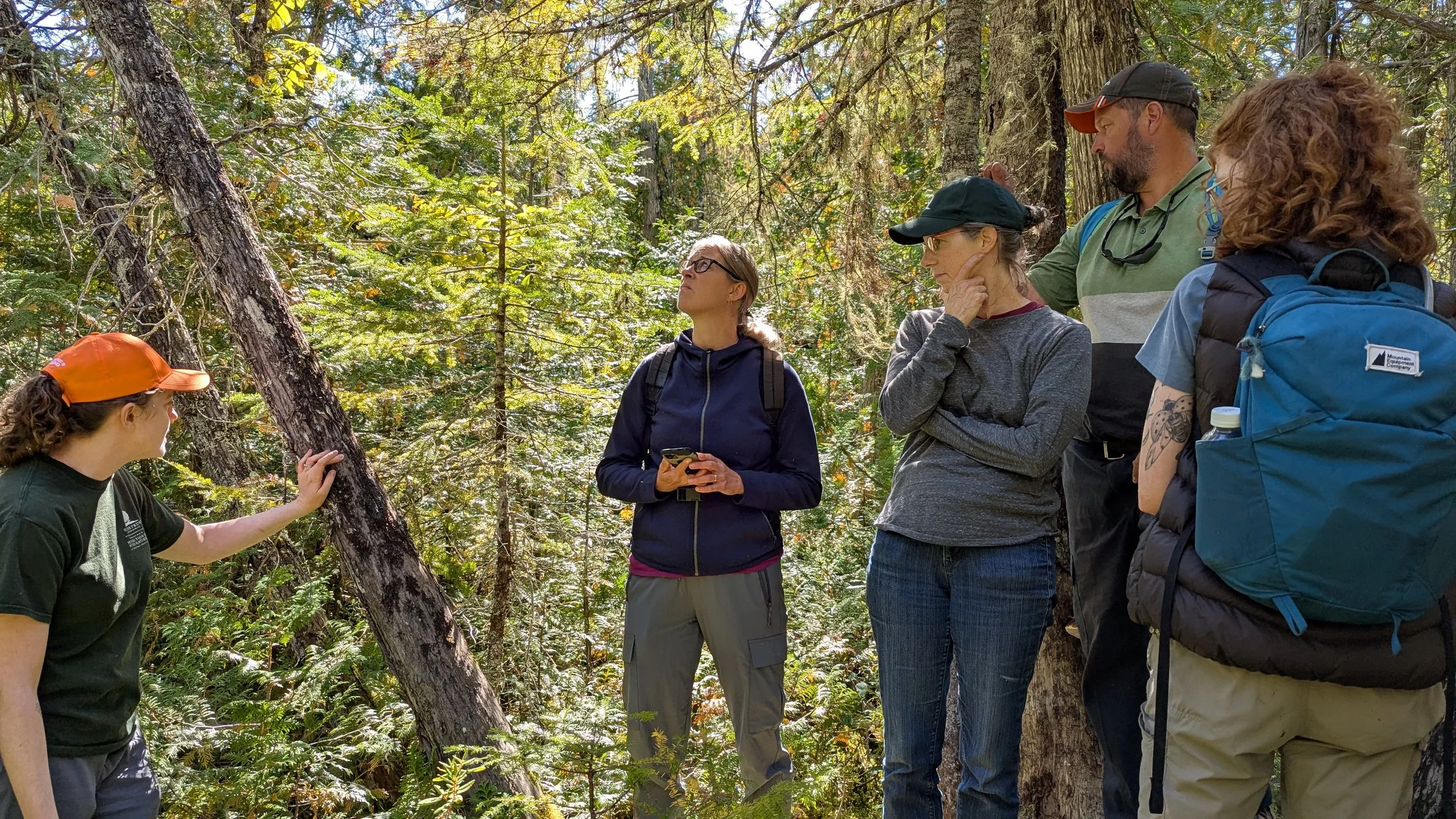
📸 Ilana Urquhart, conservation coordinator with the Nature Trust of New Brunswick (far left), shows workshop participants the rare lichen species she discovered on a leaning cedar tree at Beardsley Hill Nature Preserve in Woodstock, N.B.
That’s what brought Ilana and her workshop group to the cedar swamp at Beardsley Hill. As a charitable land conservation organization, the Nature Trusts protects nearly 15,000 acres across 98 nature preserves in New Brunswick. In addition to caring for the land it acquires and protects, the group provides information and stewardship advice to private landholders through its Conservation Partners Program. The forested wetlands workshops were geared toward land managers and professionals, as well as landowners, to help them better understand the ecosystems under their care. In addition to support from the Environmental Trust Fund, several grants from Environment and Climate Change Canada (Priority Place program and Habitat Stewardship Fund) support the Conservation Partners Program.
At the time of the workshops in September 2025, New Brunswickers were feeling the impacts of drought, and the province was under extraordinary fire risk. It was a poignant time for landholders to learn, on the ground, how to identify forested wetlands which store water during floods, to be slowly released in dry periods. This was driven home during the workshop at Killarney Lake Park in Fredericton, where, after weeks of drought conditions and seemingly bone-dry woods, a wetland delineator turned over a shovelful of dark, rich soil in a forested wetland, revealing moisture just beneath the surface.
The workshop series, including a third event held in St. Stephen, drew more than 40 attendees. Participants learned how to recognize a forested wetland, how wetlands are delineated, what regulations apply to forestry activities there, methods for measuring soil carbon, and how to care for the unique species found in these ecosystems. At each workshop, Indigenous presenters offered important insights about historical land uses, methods of harvesting, and the cultural significance of various species, such as the use of Black ash for basket making.
New Brunswick hosts various types of forested wetlands, including Silver maple (Acer saccharinum) floodplains, and swamps dominated by Black spruce (Picea mariana) and tamarack (Larix laricina), or by Eastern white cedar (Thuja occidentalis), Black ash (Fraxinus nigra), Red maple (Acer rubrum), or often a combination of those species. Forested wetlands are defined by having at least 30 percent tree cover, with trees being at least six metres tall, and a water table at or near the surface, making the ground saturated seasonally or year-round. Typical understory plants include sphagnum mosses, Sensitive fern (Onoclea sensibilis), Cinnamon fern (Osmundastrum cinnamomeum), jewelweed (Impatiens capensis), and Jack-in-the-pulpit (Arisaema triphyllum). The soils have a black organic layer at least 10 centimetres thick, with the water table at or near the surface, which can be seen by digging a pit at least 45 centimetres deep and watching for it to fill with water.
Best practices in caring for forested wetlands include leaving them undisturbed and protecting them with a 30-metre buffer of undisturbed natural vegetation. If rare lichens are found within the area, a buffer of 100 metres will better protect the humidity and growing conditions they need. Leaving water to flow naturally, including protecting areas modified by beavers, will help to maintain forested wetland habitat. And by maintaining connectivity between forested wetlands, you also provide corridors for animals like deer and moose to move through.
Under New Brunswick’s Clean Water Act, a Wetland and Watercourse Alteration Permit is required for any alteration in or within 30 metres of a wetland or watercourse, including infilling or draining, building a road, culvert, or structure, or cutting trees or changing vegetation cover. This applies to wetlands that are one hectare or larger, or wetlands that are connected to watercourses.
Through the Nature Trust’s Conservation Partners Program, landholders can receive a free site visit, and have staff survey their forest and forested wetland for rare species, providing tailored recommendations for stewarding the area. “Going out to the cedar swamp with a crew from the Nature Trust was to experience people totally enthused with their work,” says Mike Hickey, a woodlot owner in Hampton, N.B., who found this consultation valuable as part of his ongoing efforts to improve the climate resilience of his land.
If you are a New Brunswick landowner who is curious to learn about vulnerable species living in your forested wetland, reach out to the Nature Trust at conserve@ntnb.org to book your free site visit for the coming season. We can’t guarantee your feet will stay dry, but we're confident you’ll come away with a deeper appreciation for the swampy or soggy parts of your woodlot – and the wondrous species living there, just waiting to be discovered.
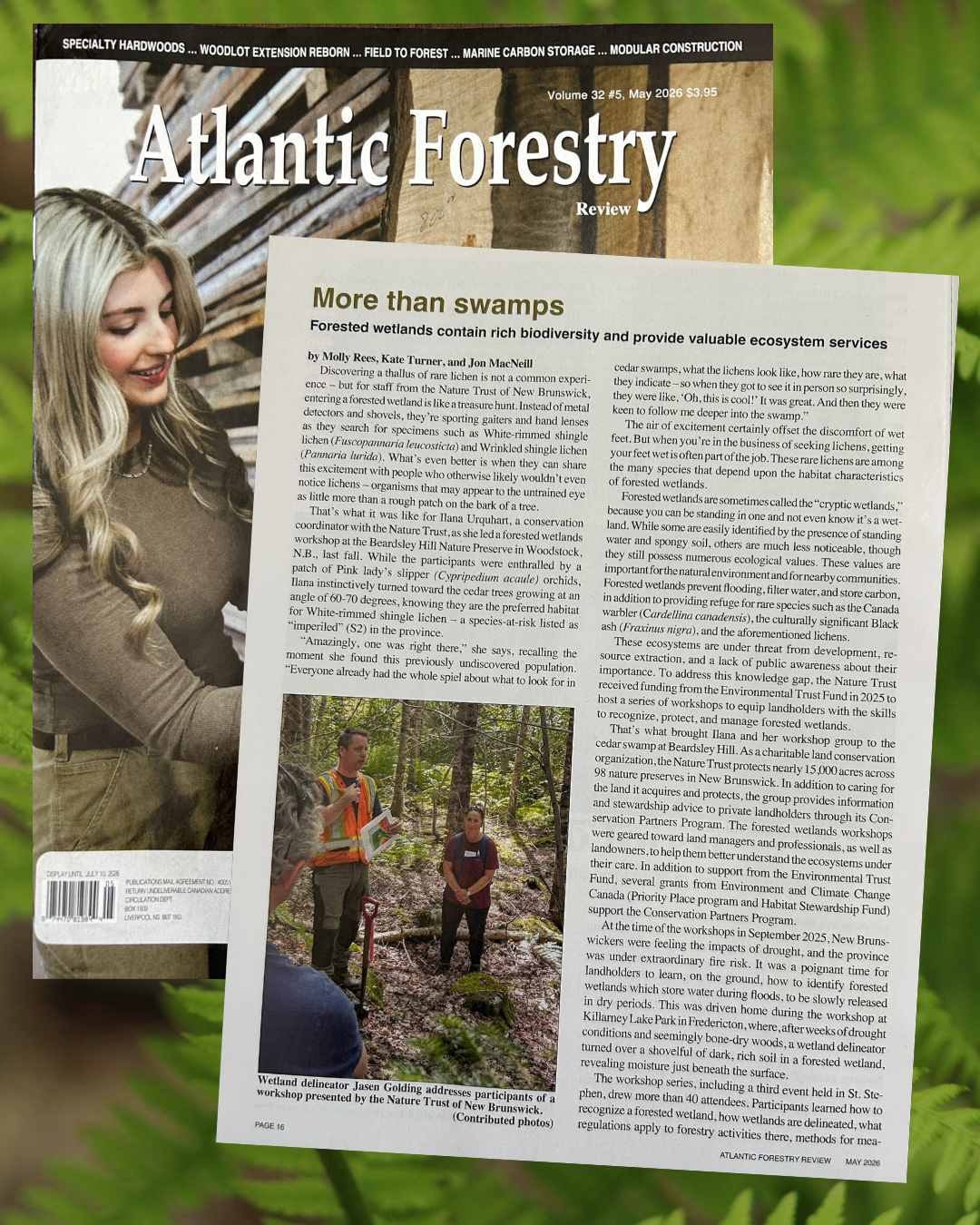
This article was also published in Volume 32 of the Atlantic Forestry Review in May, 2026