From clearcut to comeback
From clearcut to comeback
Through patience, expertise, and care, chantal Côté-DeMerchant is restoring a rare and resilient forest
WRITTEN BY JON MACNEILL, COMMUNICATIONS & ENGAGEMENT MANAGER
Chantal Côté-DeMerchant was sitting around the campfire when she heard it—a distinct call from far off in the forest that cut through the crackle of burning wood and cackles of amused friends.
“Who cooks for youuu?”
A wildlife technologist by training, Chantal recognized the song of the barred owl right away. As bird calls go, it’s a pretty iconic one—but it certainly hadn’t been a familiar sound at her Summerville camp. The camp sits on a small hill within Chantal’s 85-hectare woodlot, which had been completely clearcut just before she purchased it.
“I started calling the owl in, and it came right to the camp,” Chantal says. “It was the first owl I had out here since the forest was cut. Owls need mature woods with cavity trees. We’re starting to get some of those trees back, and so the owls are starting to come back, too.”
Any night you can call an owl to your doorstep is a special one. But this night carried even more weight for Chantal. It was one of the first clear signs that all the work she’d been doing over the past decade to rehabilitate her heavily-forested land back into a parcel of healthy Appalachian Hardwood Forest was paying off.
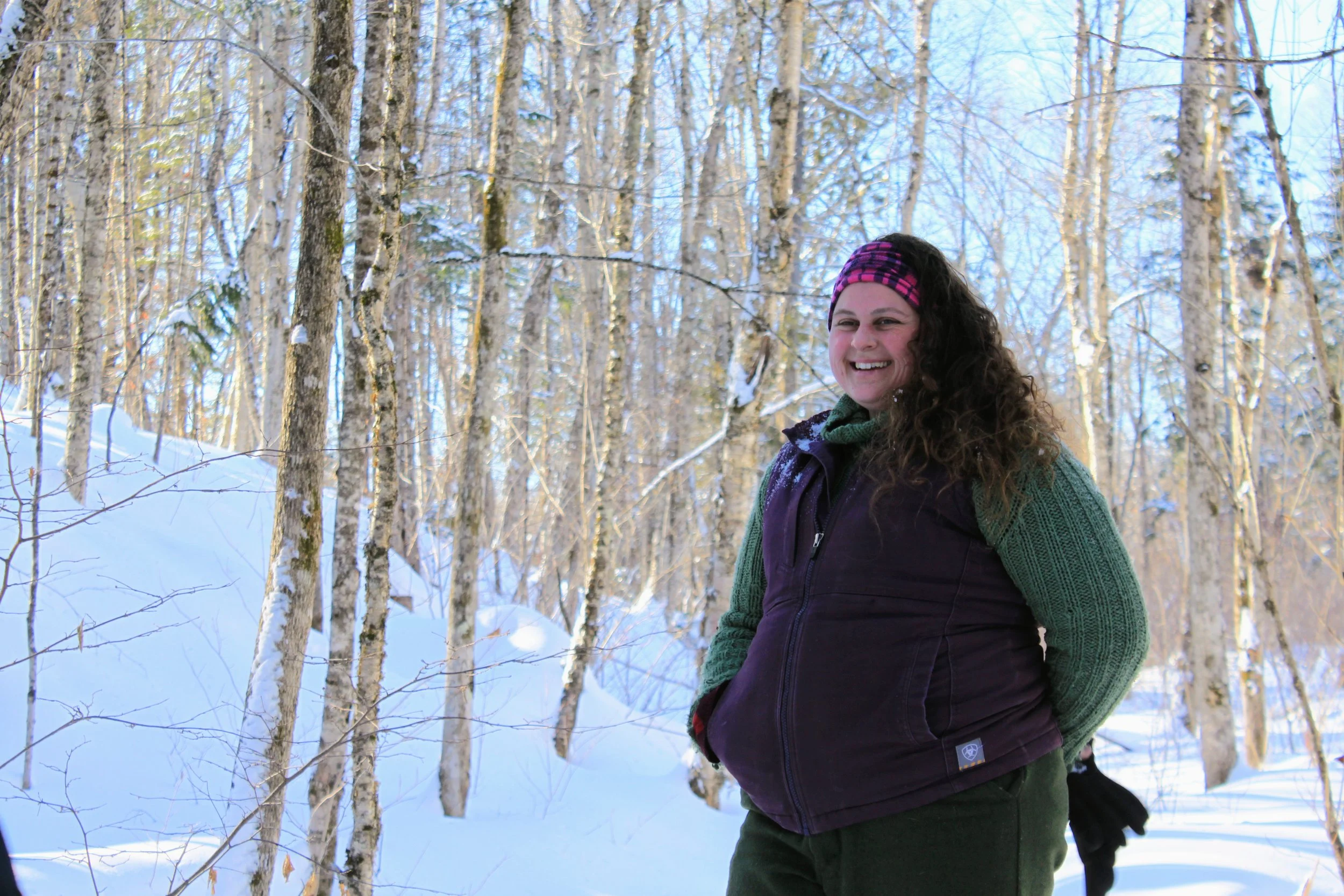
Chantal Côté-DeMerchant. (Credit: Molly Rees /Nature Trust of New Brunswick)
Chantal is the silviculture manager at the Carleton-Victoria Wood Producers Association. She and her small team provide guidance on managing working woodlots to the roughly 3,000 landholders in their region.
She’s also a member of the Nature Trust’s Conservation Partners Program (CPP), a voluntary service that helps landholders manage their forests for conservation and habitat values, alongside timber harvesting.
She’s been a member of the CPP since the mid-2010s when the Nature Trust reached out as part of our work to identify and protect remaining stands of Appalachian Hardwood Forest (AHF).
AHF is one of the oldest and most productive ecosystems in North America. Growing in a belt across York, Carleton and Victoria counties, AHF is characterized by well-draining, calcium-rich soils that produce lush and abundant understory vegetation. These conditions can result in clusters of rare and uncommon plants not typically found in such concentration elsewhere in Atlantic Canada.
But because the soil is so good, vast tracts of the landscape were cleared for agriculture, and today, less than one per cent of the original AHF remains standing.
When Chantal purchased the woodlot in 2012, it was firmly part of the 99 per cent that had been wiped out.
“A buncher had come in and taken the whole property. They took limbs. Stumps. Chipped everything. It was a pretty extreme operation,” Chantal says.
Even still, she had a good feeling about the land.
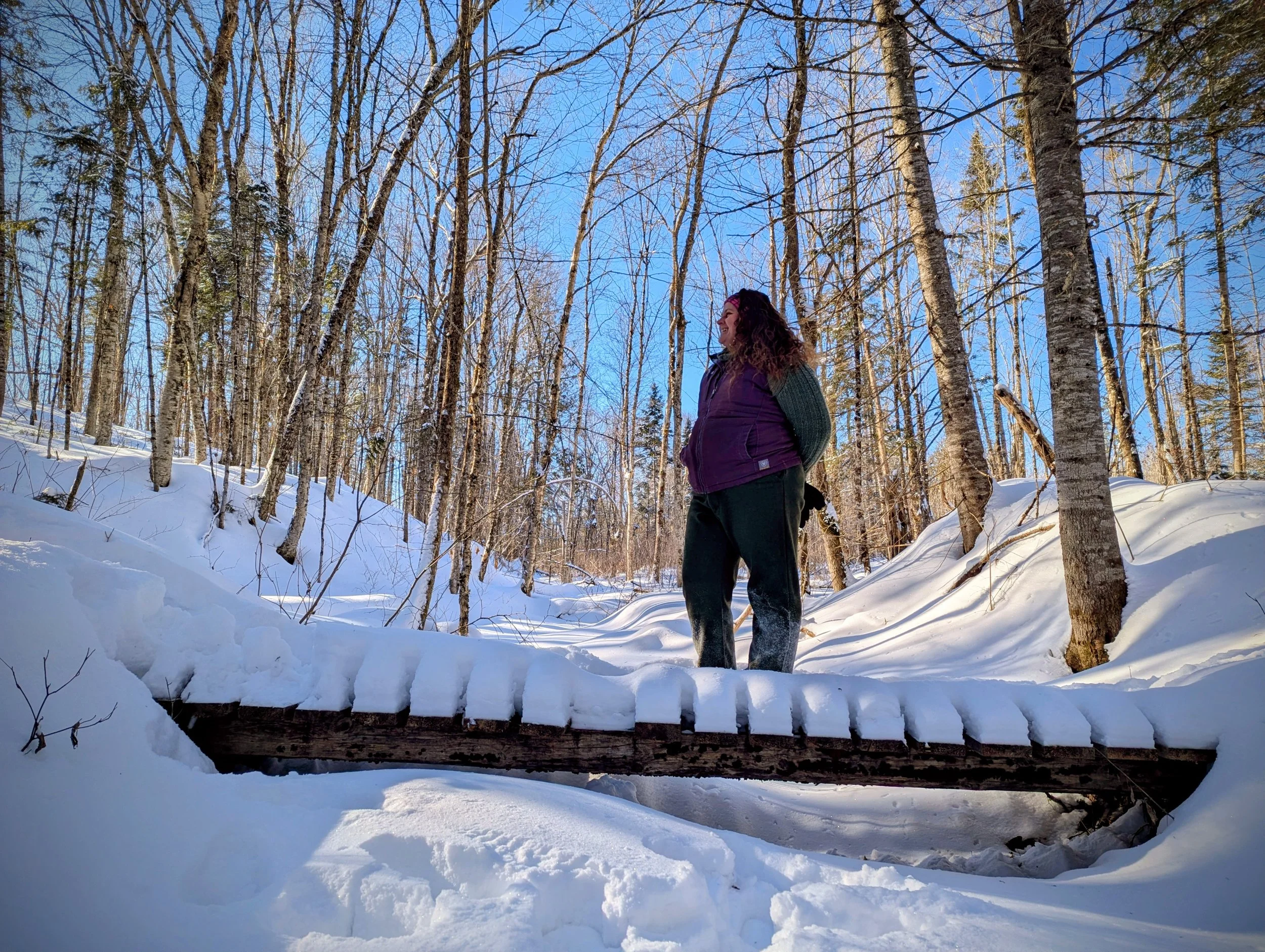
“I just knew there was something about this place,” she says as we set off into the knee-deep snow. “There's a little wet hole down there, and to see the species diversity. It was all regen, but there was elm, there was sugar maple, there was birch and popple and butternut, even just in this little patch.
“So I could see the potential."
Chantal knew what she wanted from the property: a space where she could strap on her snowshoes and spend hours exploring—spotting wildlife, deciphering tracks, hearing a bird sing and calling it back to her camp.
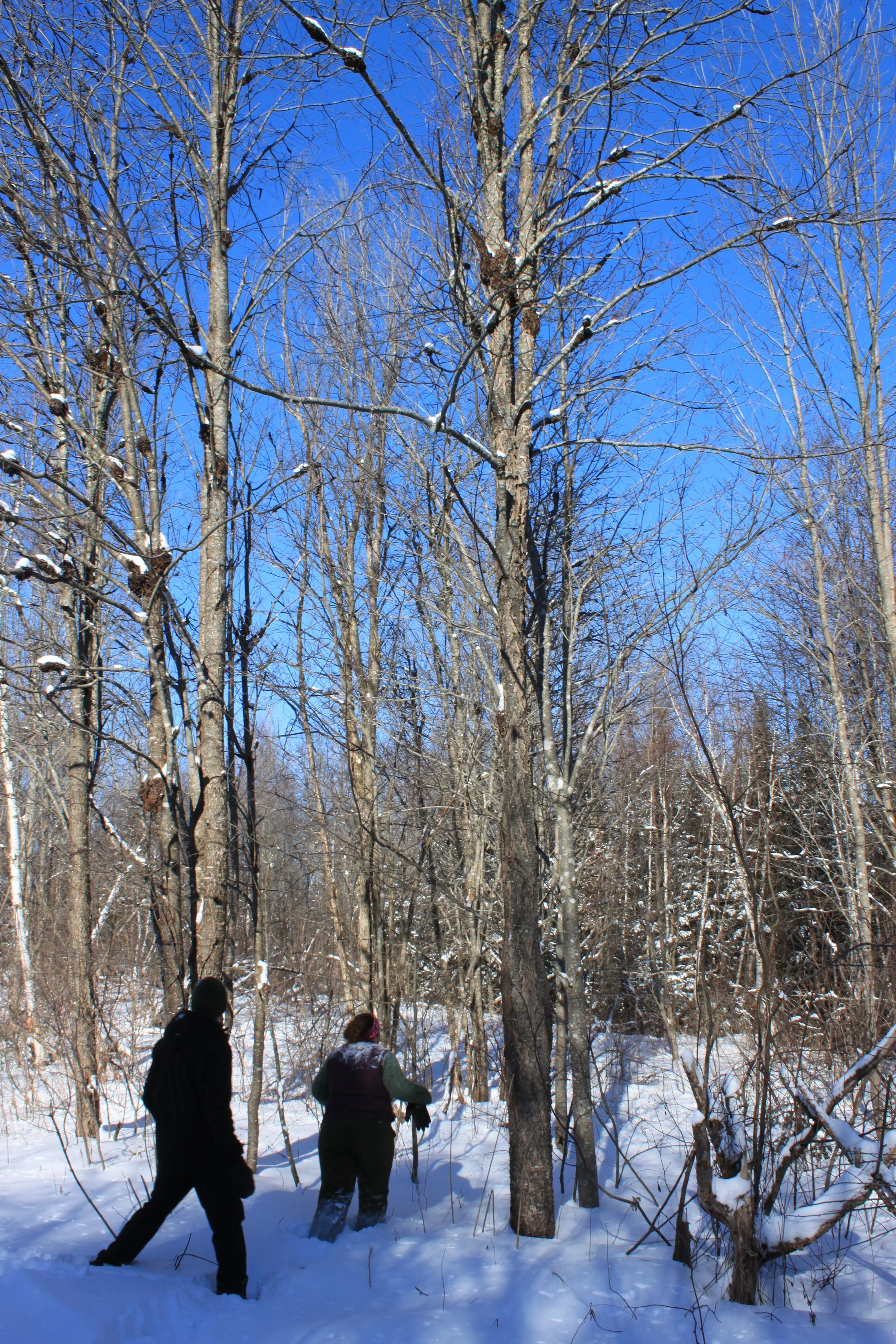
The Nature Trust’s Jon MacNeill, left, and Chantal walking past a black cherry. (Credit: Molly Rees /Nature Trust of New Brunswick)
She patiently got to work.
After the woods had grown back a little over a decade, Chantal hired her colleague at the marketing board to do some pre-commercial thinning. She didn’t want just any contractor who might thin indiscriminately; Chantal had a picture of the woods she wanted in her mind, and she knew her friend could execute that vision.
“I wanted someone who knew the species. So he was making sure to save the little baby maple that were just coming up underneath the popple. A yellow birch, an ash, beech—it has its place.
“I even asked him to keep things like alternate-leaf dogwood. We do have some stands around us now that are getting to the age that woodpeckers are going to start nesting. And woodpeckers really like alternate-leaf dogwood berries.”
As she tells us this, almost on cue, we come across a snag with distinct square holes pecked out.
“See, we have a cavity tree right here, it looks like a pileated’s been in that one. Stuff is starting to die, so we can have some habitat.”
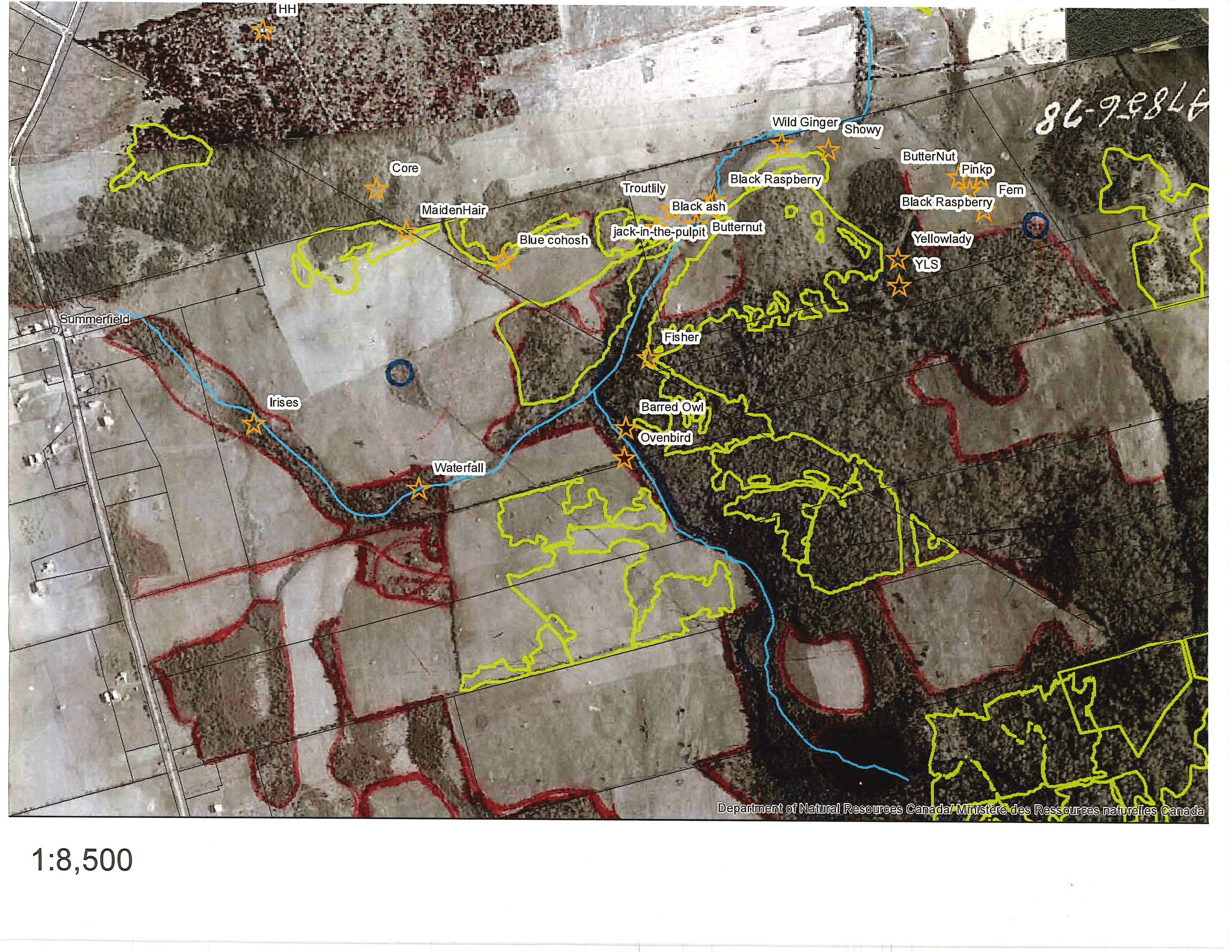
If Chantal has been intentional in curating the type of woods where she wants to spend her free time, it’s because she’s genuinely excited by the discoveries awaiting her on each hike. Before we’d even set out into the woods from the camp, Chantal pulled out a map of her property dotted with orange stars denoting the locations of different animals and plants she’s encountered.
The barred owl is on there. She marked the fisher that she’d spotted scavenging some apples she’d left out, thinking to herself, “I guess they’re a bit opportunistic.”
There’s the section she nicknamed ‘butternut grove.’ A black raspberry patch near a stand of black ash and clusters of jack-in-the-pulpit.
And there's the first showy lady slipper she’d ever seen. She’d spotted the single, rare orchid during her first outing with the Nature Trust in 2016. Today, a healthy patch is growing.
She’s also so intentional in how she manages her woodlot because she knows how special the AHF is. It’s exactly the type of forest she’s trying to bring back.
“It's so slow growing, it's not like it comes back up overnight,” Chantal says. “A balsam fir stand, you cut it, you're going to have balsam fir come back up, and in 40 years, you're cutting it again.
“This,” she says, gesturing to the hardwoods before her, “we’ve got long-term growth here. Two hundred years to get something that's actually worth looking at. So, what we do have, we need to make sure it keeps growing forward, so you get it to its full potential.”
And it’s still a working woodlot. While she never wants to see it clearcut again, Chantal says she and her partner will harvest trees via selective cut as needed or when the stands call for it.
This fall, for example, the transmission went in their truck. A stand of spruce was getting to the age where it would soon start to fall. So they harvested it and put the proceeds toward the repair.
Chantal likes demonstrating that there is more than one way to manage a woodlot. One of her favourite things about working at the marketing board is coaching landholders who are excited about alternatives to the grow, cut, plant cycles of coniferous crops.
“When you meet the ones who are like, ‘I really want to look after this,’ it’s fun.”
It was a treat for her, then, when the Nature Trust asked to include her property in an event two years ago. Visitors toured three CPP member woodlots: one managed exclusively for conservation, one for a mix of conservation and timber, and Chantal’s—an example of a forest being carefully brought back after extreme cutting.
“With this property, what I like people to see is, we had nothing here. This property was completely clearcut. And it has come back,” she says. “So if you are feeling doom and gloom, like we’re destroying all the forests, it will come back if you let it. We will have the stuff that we thought we lost—you just have to spend the time to find it.”
Sometimes, that sounds like an owl calling from restored woods—asking, once again, ‘who cooks for you all?’
What makes this forest worth the wait? Discover why Appalachian Hardwood Forests are among the most unique—and threatened—ecosystems in our region —> Uncovering the remarkable resilience of the Appalachian Hardwood Forest.
Do you own forested land? Our Conservation Partners Program offers free, personalized guidance to help you care for your property while protecting its natural value. Learn what’s possible on your land.
This article was produced thanks to the generous support of the New Brunswick Wildlife Trust Fund
